
The Labour Market Impact Assessment (LMIA) is the foundation Canadian’s temporary system and frequently the permanent system of immigration. As the date for 2026 nears employers and foreigners should be aware of the way LMIA requirements are changing and what to expect from the policy changes and how to create applications that comply with the strictest requirements.
Below is a thorough description of LMIA requirements, as they are scheduled to be implemented in 2026, taking into account the current rules, trends, and the recently announced policy direction. Always confirm the details by consulting the official Government of Canada sources at the time of application, since regulations may change.
What Is an LMIA and Why It Matters in 2026
A LMIA is a form of documentation that is issued through Employment and Social Development Canada (ESDC) that evaluates the effect hiring foreign workers on the Canadian labor market. An “positive” or “neutral” LMIA is a reference to:
- There is a pressing requirement for an international worker to fill the position.
- No Canadian Permanent residents or citizens are in the position to perform the task.
- Employing foreign workers is not going to negatively impact the Canadian labor market.
By 2026 LMIA needs will remain the main requirement to:
- Temporary foreign Worker Program (TFWP) positions.
- Many employers drive permanent residence paths (e.g., certain Provincial Nominee Programs and streams sponsored by employers).
- Certain work permits are not LMIA-exempt in international agreements or policies.
In the event that labour markets tighten in certain sectors, and relax in other areas, the government is expected to keep or even increase LMIA standards to safeguard Canadian workers, while also addressing crucial labour shortages.
Core LMIA Requirements (Expected Framework for 2026)
While the specific thresholds and forms could be modified, the basic LMIA requirements for 2026 are likely to be based on the following three pillars:
- Genuine job offer and a business’s legitimacy**
- Recruitment efforts to recruit Canadians or permanent residences**
- Working conditions and wages that exceed or meet standards.**
- Labour market benefits along with sector-specific laws**
- Record of employer compliance and risk assessmentfor employers**
Let’s examine each one in greater in detail.
3. Employer Eligibility and Business Legitimacy
To be eligible to be the position of LMIA by 2026 employers have to prove they are legitimate, operating and capable of fulfilling the conditions that are in the offer.
The most important elements are typically:
- Registered Business: Evidence that the company was registered, incorporated and partnership documentation.
- Active operations: Recently issued invoices and financial statements, contracts, or evidence of ongoing business actions.
- Ability to pay wages: Financial documents (e.g. T4 summaries, T4 reports and bank statements, and payroll records) that demonstrate the capacity to pay for the salary.
- Compliance history: A clean history of compliance with the TFWP and no major violations in the past or administrative penalties that have not been paid or bans.
ESDC is increasingly using assessments based on risk. In 2026, companies with previously resisted compliance or who are working in high-risk industries can anticipate:
- More detailed document requests.
- Possibility of interviews or site visits.
- Longer processing times.
4. Job Offer Requirements: Wages, Duties, and Conditions
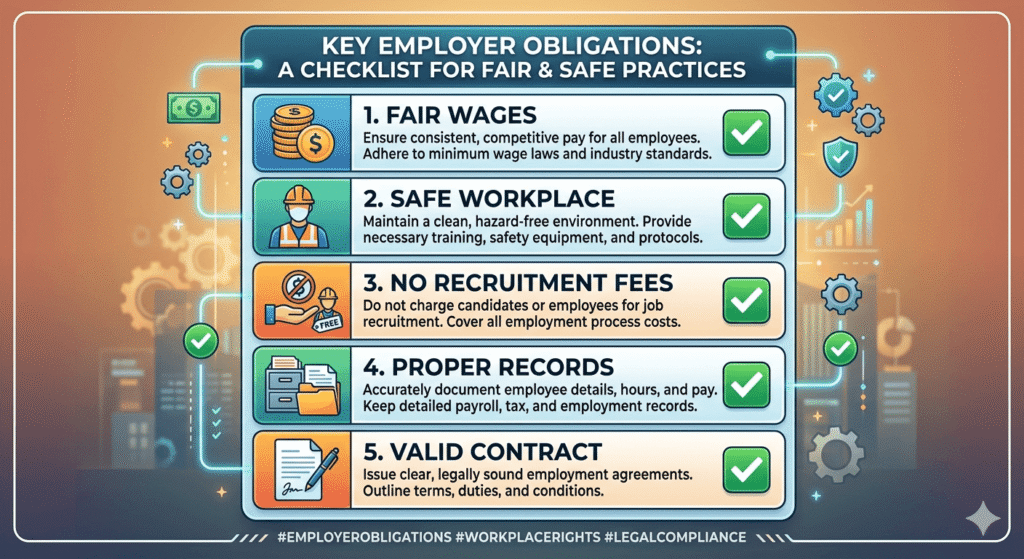
The job advertisement should be clear, authentic and in line in accordance with Canadian standards.
4.1. Wages
By 2026, the wages are expected to be compared against:
- Prevailing wage for the profession and the region, based on data from the government on wages.
- Collective agreements, in the event that your job is unionized.
- Internal wage structure, to ensure that foreign workers aren’t paid less than similar Canadian workers.
Employers must:
- Offer at minimum the median wage for the position within the area (or more if it is allowed by the rules of the program).
- Adjust wages in the event that the wage prevailing increases prior to or during the period of employment in accordance with the direction of ESDC.
4.2. NoC and Duties alignment
The job description must include:
- Match the National occupational classification (NOC) code that you choose.
- List specific details of the duties, responsibilities and necessary qualifications.
- Reflect real operational requirements Not artificially exaggerated or downgraded positions.
The misalignment of the duties and NOC is the most common factor in LMIA refusals, and is likely to be the main reason for refusals until 2026.
4.3. Conditions of work
Employers must demonstrate:
- Conformity with the federal and provincial labor standards** (hours of work and overtime, vacation time or legal holidays).
- Safe workplaces that meet the occupational health and safety* standards.
- The same benefits are offered to Canadian employees in similar positions (where appropriate).
5. Recruitment Requirements: Proving Efforts to Hire Locals
A major area of scrutiny for LMIA obligations is recruiting. Employers in 2026 must prove that they have made legitimate and documented efforts to recruit Canadian citizens and permanent residents prior to converting to foreign employees.
Common recruitment requirements comprise:
Advertise the position for at minimum a of (often at minimum 4 weeks) during the 3 months preceding the submission of the LMIA.
Posting on multiple platforms, for example:
- Government job banks (e.g., Job Bank).
- Regional or national job boards.
- Industry-specific websites or professional associations.
- Targeted recruitment for groups that are underrepresented when relevant (e.g. young people, Indigenous peoples, newcomers).
Employers must offer:
- Copy or screenshots of job advertisements.
- More detailed information about:
- The places where ads were displayed.
- The duration of each posting.
- The number of applicants and reasons for rejecting.
By 2026, electronic monitoring of recruitment efforts (e.g. analytics or reports from applicant tracking systems) could be more frequently requested to confirm that the recruitment process was genuine and active and not merely an exercise in formality.
6. Program Streams and Sector-Specific Rules
LMIA requirements differ by sector and stream. While the basic principles remain the same however, 2026 could be a time of continued distinction between:
6.1. High-wage vs. low-wage positions
- High-wage positions (above the provincial/territorial median wage):
- It is common to require a “transition plan that outlines how the employer intends to reduce the dependence on foreign workers in the future (e.g. in training Canadians or upskilling staff already in place).
- May have greater flexibility with caps, but more rigorous scrutiny of the long-term workforce strategy.
- Low-wage job positions(below the median wage) (below what is the average wage):
- subject to limits on the percentage of foreign workers earning low-wageper worksite.
- You may also be subject to additional conditions like:
- Limits on length of work.
- Requirements for employer-provided transport or housing in certain regions/sectors.
6.2. Agriculture and seasonal work
The industries of agriculture and seasonality (e.g. tourism, seafood processing) typically have customized LMIA streams. In 2026, these streams are anticipated to be in the future, including:
- Specific rules for recruitment that are adapted to the seasonal cycle.
- Standards for housing transport, housing and health insurance.
- Continuous focus on preventing abuse and ensuring safe work and life conditions.
6.3. Global Talent and streams with specialized content
Tech-related and high-skilled occupations could still benefit from more efficient procedures, including:
- Processing times are reduced for jobs that are in demand.
- Simple requirements for recruitment in specific categories.
But, even in the fastest streams, employers have to:
- Provide competitive salaries.
- Show that you have a genuine business need.
- Follow-up with all requirements for follow-up and inspection.
7. Transition Plans and Long-Term Workforce Strategy
For the majority of high-wage LMIAs the transition strategy will be required and will likely to be so until 2026. The plan for transition outlines how employers will:
- Recruit and train Canadians as well as permanent resident.
- Reduce dependence of temporary workers during time.
- Supporting training, development and internal promotion.
Common elements include:
- Training programs – Evidence of the training for current staff.
- Partnerships with training institutions, educational institutions or providers.
- Planning for succession in key tasks.
When it comes to future LMIA application or inspections, ESDC may review whether employers have followed through on their prior commitments to transition, making the need for accurate and realistic planning.
8. Worker Protections and Employer Compliance
Safety of workers is at center of LMIA regulations Enforcement is steadily growing. In 2026, businesses can anticipate:
- More frequent inspections Both random and risk-based.
- Visits on-site interview of foreign as well as Canadian workers, as well as document reviews.
- Administrative financial penalties or bans, as well as public naming for serious offenses.
Employers must:
- Offer foreign workers an employment contract that is writtenin accordance in accordance with LMIA as well as the job offer.
- Don’t alter the important terms (e.g. wage and duties, location of work) without a valid authorization.
- Ensure that employees are not paid recruitment fees from the employer or by third-party recruiters unless they are the law prohibits it.
Record all of your records in detail for several years, which include:
- Timesheets and payroll.
- Proof of deductions and benefits.
- Transportation and housing arrangements (if necessary).
Foreign workers must be informed of their rights. This includes:
- Access to provincial labor standards offices.
- Right to maintain passports and other personal documents.
- the right to decline unfit work.
9. LMIA Application Process: Step-by-Step Overview for 2026
While forms and portals could be up-to-date by 2026, the standard LMIA application process is likely to be based on these steps:
1. Determine which stream is the most appropriate.
High-wage, low-wage agricultural seasonal, specialized or stream that is expedited.
2. Check the latest requirements
Review the ESDC/Service Canada guidelines for 2026, which include advertisements, wage tables and sector-specific notes.
3. Conduct recruitment
- Advertise the job in accordance with current regulations.
- Record all recruitment efforts and results.
4. Prepare documentation
- Financial and business registration documents.
- The job description should be detailed and include an contract of employment.
- Evidence of recruitment and, if needed an exit plan.
5. Submit an application for the LMIA request
- Through the online portal or any other methods as approved by ESDC.
- Pay the processing fee (unless the processing fee is exempt under a specific program).
6. Respond to follow-up questions
- Submit any additional documents or clarifications required by ESDC.
- Participate in site visits or interviews when necessary.
7. Receive an email with the LMIA determination
If you are positive, give if you are positive, provide the LMIA confirmation number and the job proposal to a foreign employee in order to obtain the work visa or for their permanent residency application.
If rejected, look over the reasons for refusal, and then consider whether an amended application is necessary.
10. Anticipated Trends and Policy Directions for 2026
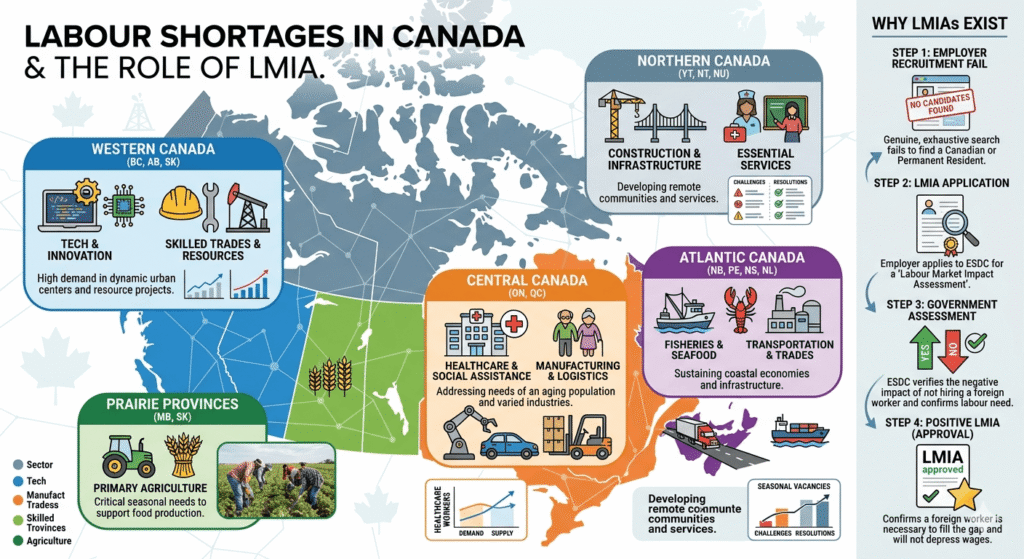
_ Although the exact 2026 regulations will be determined by government decision-making prior to the date, there are several trends likely to influence LMIA regulations:
_ Data integration is improved Use of more the labour market and other digital tools to analyze the real-time availability of workers and verify recruiting efforts.
_ A stronger enforcement strategy A continued emphasis on inspections, penalties and transparency for employers that aren’t in compliance.
_ Flexible and targeted: Streamlined procedures for high-skilled and critical sector jobs, tempered by stricter regulations in areas of high unemployment or previous abuses.
_ Worker-centric policies: Improved protections, more clear information for workers, as well as more avenues to report violations or abuse.
_ Employers who are prepared and maintain strong HR policies and approach LMIA compliance as a continuous obligation, not a once-off paperwork exercise will be best in a position to adjust.
11. Practical Tips for Employers Preparing for 2026
To follow LMIA requirements efficiently in 2026:
_ Begin early: Incorporate timeframes for documentation and recruitment into your work schedule.
_ Create standardized documentation: Develop internal templates for contract descriptions, job descriptions and logs of recruitment.
_ Monitor wage information Check regularly for updated wage data for your region and work.
_ Make sure you invest in training. Develop internal training and development programs to aid your plan for transition.
_ Audit to ensure compliance. Conduct regular internal audits of your contract, payroll as well as working and conditions.
_ Choose reputable partners: When working with consultants or recruiters make sure they are aware of LMIA rules and adhere to the ethical and legal guidelines.
12. Help for Workers from Other Countries
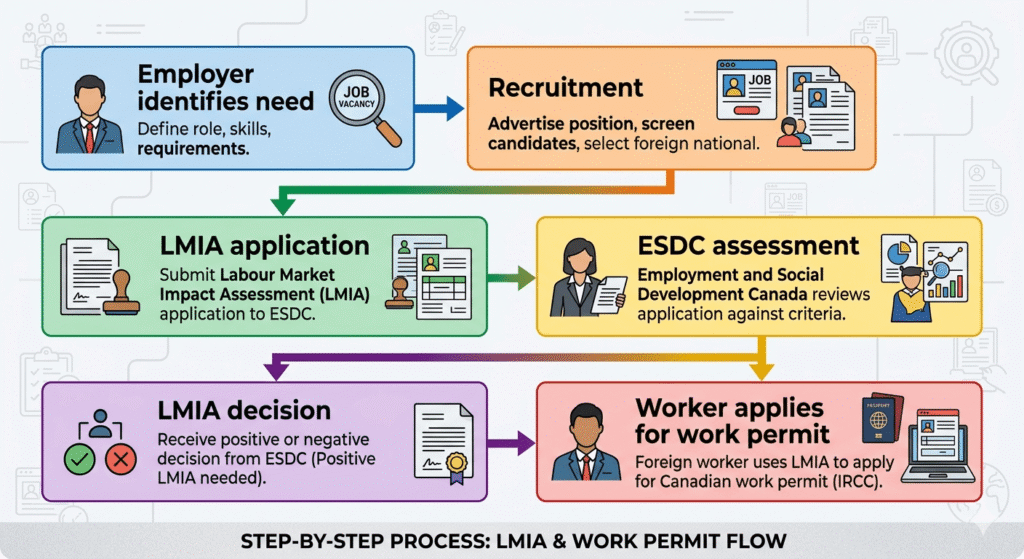
For foreign workers who are thinking about jobs that need an LMIA in 2026:
- Check out the employer: Get the LMIA confirmation number and check the information in your work permit application.
- Know what your contract says: Make sure the terms of your LMIA contract (wage, duties, hours, location) are the same as those in your contract.
- Know your rights: Learn about the labour standards in your province and how to get help if you need it.
- Keep copies of important papers like your contract, pay stubs, and any emails or letters you send to your boss.
Knowing things helps keep you from being taken advantage of and makes your immigration process go more smoothly.
Understanding LMIA requirements for 2026 is essential for both employers and foreign workers. By focusing on genuine labour needs, fair treatment, and thorough documentation, stakeholders can navigate the system more confidently and contribute to a balanced, responsive Canadian labour market.
Discaimer:
_ The information contained in this website is for general information purposes only. The website focuses on connecting job seekers with potential employers and provides relevant job search resources.
_ Please note that if you find any job closed, we will update that job as soon as possible. or Find current job openings Here.
Leave a Reply